
What Is the Biggest Spider in Michigan?
Quick answer: The dark fishing spider (Dolomedes tenebrosus) is Michigan's biggest spider by leg span, with large females stretching 3 to 4 inches across. If you're measuring by body size and bulk instead, the Carolina wolf spider takes the title, with females reaching over an inch long and a stocky, muscular build. Both look intimidating, but neither is dangerous to people.
If you've ever flipped on a porch light and come face-to-face with a spider the size of your palm, you're not imagining things. Michigan is home to more than 500 documented spider species, and a handful of them get large. Below, we break down which species are actually the biggest, whether any pose a real risk, and what to do if you'd rather not share your house with them.
Michigan's Biggest Spiders, Ranked
Michigan has a handful of species that people often mistake for something far more exotic, or far more dangerous, than they actually are. Here's how the state's largest spiders stack up.
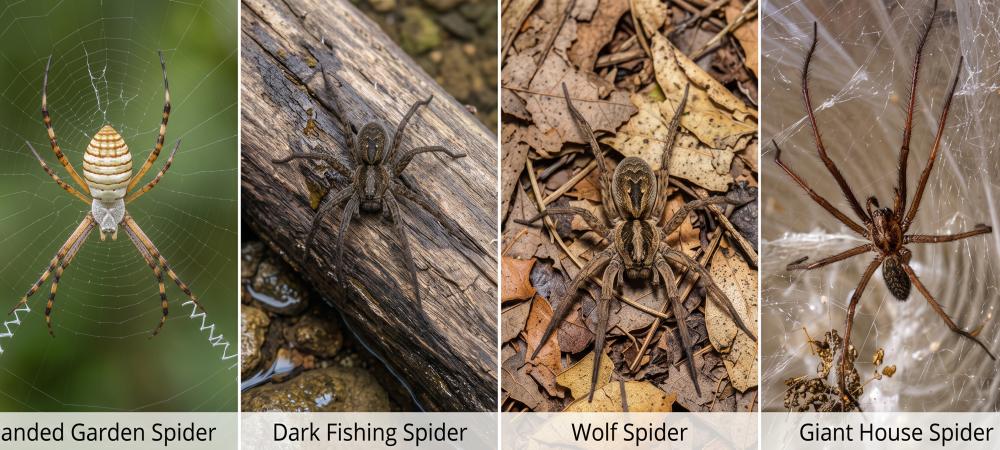
Dark Fishing Spider (Biggest by Leg Span)
The dark fishing spider is the undisputed leg-span champion. Females can reach about an inch in body length, but their long, banded legs push their total span past 3 inches, with some outliers approaching 4. They're found throughout Michigan, usually near lakes, ponds, streams, and docks, and their mottled brown coloring and flattened body help them blend into bark and rock.
Despite their size, fishing spiders are shy hunters. They ambush prey by feeling for vibrations on the water's surface rather than spinning webs, and they'll dive underwater briefly to escape a threat. They're far more interested in avoiding you than confronting you.
Wolf Spider (Largest by Body Size)
Wolf spiders are the heavyweights of the group. Michigan's largest wolf spider species, the Carolina wolf spider, has a thick, hairy body that can reach 1.2 inches long, not including the legs. Unlike fishing spiders, wolf spiders hunt on the ground and don't build webs to trap prey.
You'll typically find wolf spiders in:
- Basements, crawlspaces, and garages
- Mulch beds, woodpiles, and leaf litter
- Under stones, landscaping timbers, and porch steps
Their eight eyes, arranged in three distinct rows, give them excellent night vision and a noticeably alert, "watching you" appearance that often startles humans.
Banded Garden Spider / Argiope
The banded garden spider, part of the Argiope genus, is easy to spot thanks to its bold yellow-and-black pattern and the thick zigzag of silk woven into the center of its web. Females can grow to about 2 inches including their legs, while males stay much smaller.
These spiders are orb weavers, meaning they build the classic large, circular webs you'll see stretched across gardens, tall grass, and porch corners in late summer. They're not aggressive and rarely bite, but their size and dramatic coloring make them one of the most commonly reported "giant spiders" in Michigan yards.
Giant House Spider
Giant house spiders are among the most frequently seen large spiders indoors, especially once fall arrives. Females run about 0.5–0.75 inches long, and a mature male's leg span can reach 3–4 inches, the same range as the dark fishing spider. They build funnel-shaped webs in corners, window frames, sheds, and garages, and their long, banded legs make their overall footprint look larger than their body actually is.
They're not strong climbers, which is why homeowners often find them stuck on the floor, in a sink, or trapped in a bathtub after wandering in search of water. Once considered venomous by reputation alone, giant house spiders have since been confirmed to pose no real threat to people.
Are Michigan's Biggest Spiders Dangerous?
Quick answer: No. None of the four large spiders above are considered medically dangerous to people. Michigan's only spiders of real medical concern — the northern black widow and, rarely, the brown recluse — are actually much smaller.
This is the point where a lot of Michigan homeowners breathe a sigh of relief, and understandably so. Size and danger aren't the same thing in the spider world, and in Michigan, they're almost inversely related.
Which Michigan Spiders Are Actually Venomous
Every spider technically produces venom, but only two species in Michigan are considered a real medical concern:
- Northern black widow: glossy black body with a red or orange hourglass marking on the underside of the abdomen; most active from spring through fall
- Brown recluse: tan to brown body with a violin-shaped marking; with confirmed isolated populations limited to a handful of counties, including Genesee, Hillsdale, Ingham, and Washtenaw
Both species are shy and would rather retreat than bite. Bites typically happen by accident, such as when a spider gets trapped against skin in clothing, bedding, or gloves.
Where Do Michigan's Biggest Spiders Live?
Understanding where these spiders naturally live goes a long way toward understanding why, and when, you start seeing them around your house.
Outdoor Habitats
Michigan's biggest spiders are drawn to specific outdoor conditions:
- Dark fishing spiders stick close to water: docks, streambanks, ponds, and damp wooded areas
- Wolf spiders prefer open ground with cover, like mulch, leaf litter, and woodpiles
- Argiope spiders favor tall grass, gardens, and sunny areas with room to build large webs
- Giant house spiders are comfortable in sheds, barns, woodpiles, and gaps between bricks or stones
All four species share one thing in common: they're drawn to whatever gives them shelter, moisture, and easy access to insect prey.
How and Why They End Up in Your Home
Large spiders don't usually invade a house on purpose. Most wander in while following prey, searching for moisture, or looking for a warmer place to wait out dropping temperatures. Giant house spiders and wolf spiders are especially common hitchhikers, sneaking in through gaps around doors, firewood brought inside, or boxes stored in a garage or shed.
Once a spider is indoors, it tends to stay wherever conditions match its outdoor habitat, such as a damp basement for a fishing spider, a cluttered crawlspace for a wolf spider, or a quiet window corner for a giant house spider.
When Are You Most Likely to See Them?
Quick answer: Late summer through fall, roughly August through October, is peak spider season in Michigan. That's when these species are fully grown, actively mating, and most likely to wander into view.
Peak Spider Season in Michigan
Michigan's biggest spiders reach their maximum size by late summer, right around the time mating season kicks into gear. Male spiders leave their usual hiding spots to search for females, which means more movement, more visibility, and more surprise encounters on porches, in garages, and around foundations.
This is also when web-building species like the banded garden spider are most noticeable, since their webs are largest and most active in late summer and early fall.
Why Spiders Move Indoors as Temperatures Drop
As nights get colder heading into fall, spiders start looking for warmer, more stable environments, and homes offer exactly that. Basements, garages, and crawlspaces provide the dark, quiet, humid conditions many of these species already prefer outdoors, just with less temperature swing. An indoor spider sighting often means the spider is simply following the insects, moisture, or shelter it needs to survive the coming cold.
How to Get Rid of Large Spiders in Michigan
Seeing one large spider is usually not cause for alarm, but repeated sightings, especially indoors, are worth addressing before they become a bigger nuisance.
DIY Prevention Tips
A few simple habits go a long way toward keeping large spiders outside where they belong:
- Seal cracks and gaps around windows, doors, and foundations
- Store firewood away from the house and inspect it before bringing it inside
- Reduce clutter in basements, garages, and crawlspaces where spiders like to hide
- Manage moisture with dehumidifiers or by fixing leaks, since damp areas attract both spiders and their prey
- Keep exterior lights off or switched to yellow bulbs, which attract fewer flying insects for spiders to feed on
These steps address the root cause — insects and moisture — rather than just the spiders themselves, which is why they tend to work better than swatting one spider at a time.
When to Call a Professional
If you're seeing large spiders regularly, finding webs in multiple areas of the home, or simply not comfortable identifying what you're seeing, it's time to bring in a professional. That's especially true if there's any chance a sighting could be a black widow or brown recluse rather than one of Michigan's larger, harmless species.
We approach every spider issue the same way: identify what's actually present, address the conditions drawing them in, and treat the problem at the source rather than offering a quick fix that doesn't last. If large spiders have become a regular presence in or around your home, call the pest control experts at Sergio's Pest Control at 248-587-8504 or request a free quote, and we'll help you figure out the right next step.